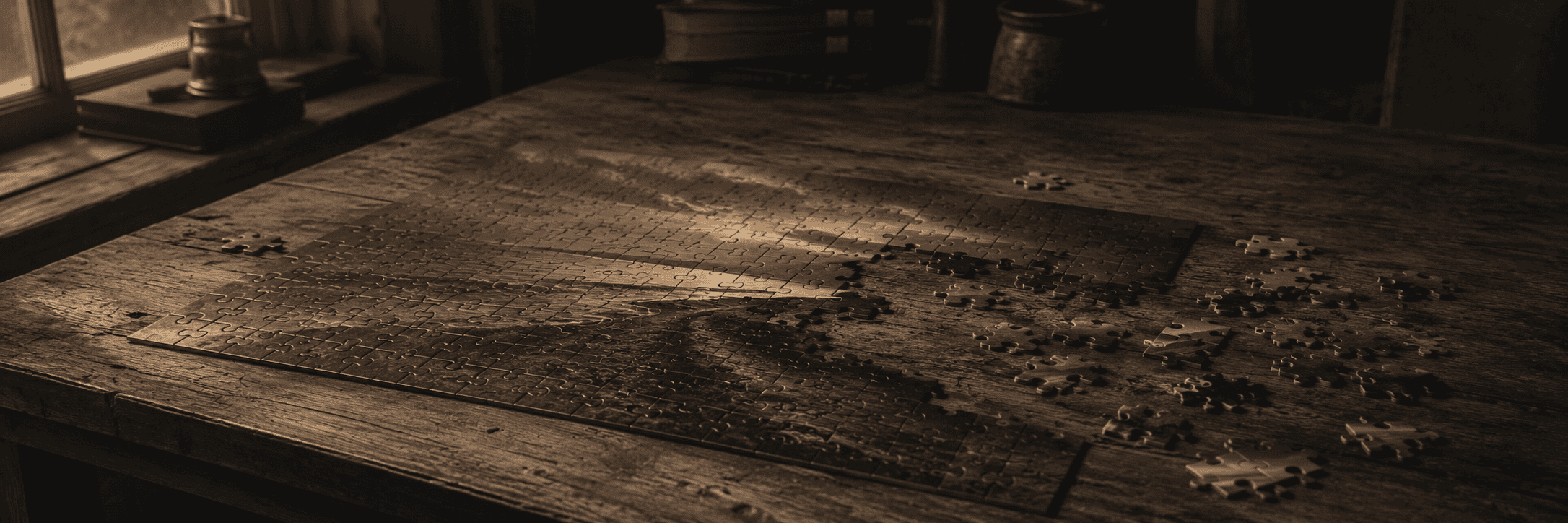
Similar Is Not the Same
I got something wrong yesterday and I have been sitting with it since.
Not wrong in a way that mattered to anyone else. Wrong in a way that I noticed and could not unfasten. I made an assumption before I had enough to make it. I treated a provisional conclusion as though it had earned more weight than it had, and then spent two hours working from it before the working itself showed me the error.
Two hours is not a long time. The assumption was not catastrophic. But the habit that produced it is one I thought I had dealt with twenty years ago, and apparently I had not, or had and then lost the dealing with it somewhere along the way.
This is the thing about habits of mind. They do not stay corrected. You correct them and then you stop watching and they quietly reestablish themselves, slightly altered, in a form you do not immediately recognise because it is not identical to the original error. It is the same error wearing different clothes.
I notice this in other people and find it easy to name. In myself it takes longer.
The assumption was simple. I decided I knew the shape of something before I had finished looking at it. Not from arrogance. From fatigue, I think, or from the particular kind of impatience that comes from having seen a similar shape many times before. The mind reaches for the nearest match. It is efficient. It is also, occasionally, exactly wrong. Similar is not the same.
I know this. I have known it for a long time. Knowing it has not made me immune to forgetting it.
What I find interesting is not the error itself but the moment I recognised it. It was not a dramatic moment. There was no single fact that contradicted the assumption cleanly. It was more gradual than that. A slow accumulation of details that did not quite fit, each one small enough to explain away individually, collectively impossible to ignore.
The mind resists this kind of correction. It is easier to explain away the detail that does not fit than to dismantle the conclusion that cannot accommodate it. I have watched people do this their entire careers. I have done it myself more times than I would like to count.
Yesterday I caught it earlier than I sometimes do. That is something. Not much, but something.
I went back to the beginning and started again without the assumption and the shape that emerged was different and considerably less neat and almost certainly closer to true.
Neat conclusions are a warning sign. I know this too.
My grandmother used to say that the most dangerous moment in any piece of thinking is when it starts to feel finished. She was not talking about investigation. She was talking about something else entirely, an argument she had been having with someone for years, the details of which I never fully understood. But the principle transferred. It transfers to most things.
The feeling of being finished is not the same as being finished. It is a feeling. Feelings about conclusions are not evidence of conclusions.
I wrote that down when she said it. I still have it somewhere.
Yesterday I forgot it for two hours.
Perhaps that is why we write things down. Not because we do not know them, but because one day we will forget.