On What Remains
I have been thinking about a case from eleven years ago. Not because anything has prompted it. Nothing has. That is the point.
A woman in Llandudno hired me to recover data from her late husband's laptop. He had died eighteen months earlier and she wanted his photographs. Not for any legal reason. She simply wanted the photographs back.
The hard drive had failed. I told her I would try and that she should not expect much. She nodded. She had the look of someone who has already spent a long time adjusting their expectations downward.
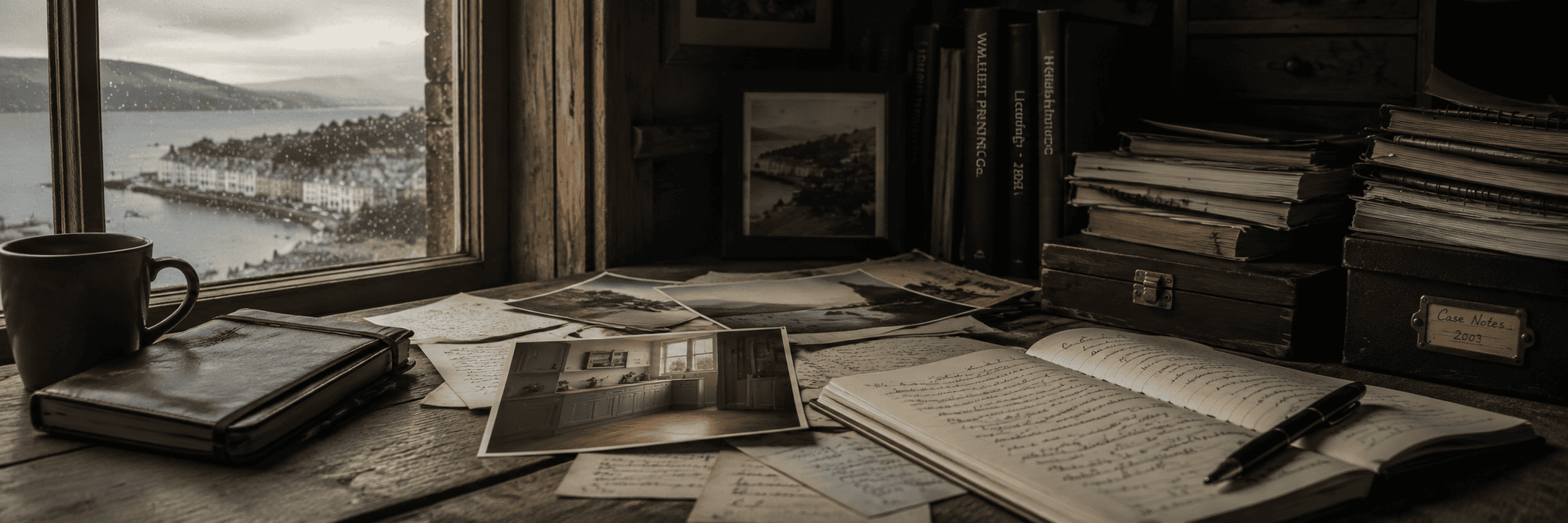
It took four days. I recovered sixty-three photographs, most of them partial. Corrupted files render faces first. What I returned to her were images of gardens, car parks, the corner of a kitchen, a window with grey light coming through it. Eleven years later I remember the kitchen. The colour of the units. The way the light sat on the worktop.
I do not know why I remember that and not other things.
She thanked me and paid and I did not hear from her again.
I have thought about that kitchen perhaps a dozen times since. Not often. Irregularly. Always without reason.
This is what I mean by what persists.
Investigators learn quickly that evidence is not neutral. The things that survive a fire, a flood, a hard drive failure, a death — they do not survive by merit. They survive by accident. The meaningful thing is often gone. The incidental thing remains for forty years.
I have seen a man's entire professional life reduced to one spreadsheet and a voicemail from his dentist. I have seen a woman survive in the record only as a signature on a form from 1961. I have opened archives expecting answers and found instead a receipt for a pair of shoes.
This is not tragedy. It is simply how things go.
What we choose to preserve says something about us. What survives our choices says something different. Last week I found a notebook I used in 2003. I do not remember keeping it. Fourteen pages of observations from a case I barely recall. The handwriting is mine and the facts are precise and I have no memory of writing any of it. The notebook persists. The memory of writing it does not.
I read through it twice. The case involved a small firm in Caernarfon and a dispute over licensing payments that had been going on since 1997. Someone had kept two sets of records. The notebook tells me I identified the discrepancy on a Wednesday afternoon and that it was raining. It tells me the office smelled of damp carpet and that there was a framed photograph of Anglesey on the wall behind the desk.
I do not remember Anglesey. I do not remember the rain.
I remember the photograph from that Llandudno case. The kitchen with the grey light. I have thought about that kitchen perhaps a dozen times in eleven years.
I have not thought about Anglesey once. Not until the notebook returned it to me.
I do not have an explanation for which things stay and which things go. I have noticed that the things which stay are rarely the things that seemed to matter at the time. The licensing dispute in Caernarfon mattered. Anglesey did not. The outcome of that case was straightforward. I wrote it up and was paid and moved on.
The kitchen in Llandudno was a corrupted file. It was not evidence of anything except a hard drive failure. The woman wanted faces and I gave her worktops and grey light.
Eleven years later it is still there, in whatever part of the mind keeps things without being asked to.
The notebook from Caernarfon had to remind me about Anglesey.
I am not sure that means anything. But I have been thinking about it for four days, which is probably a kind of answer.