Human Stories, Digital Shadows
People often imagine that history arrives in neat folders. It rarely does.
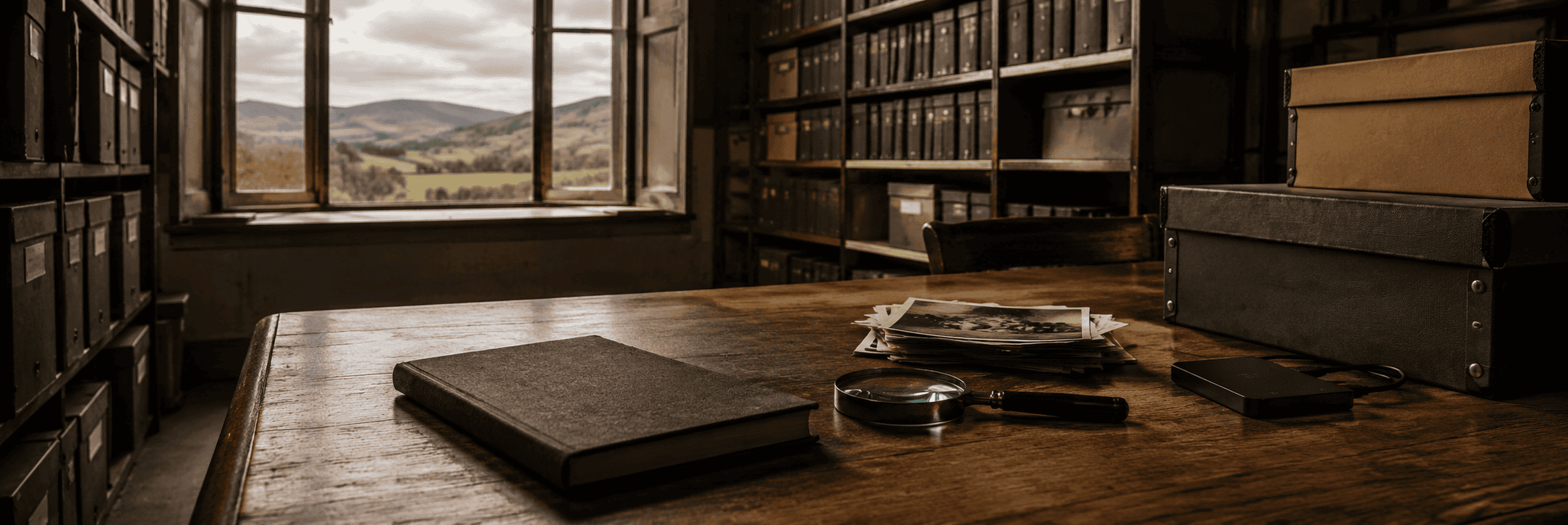
Most of the lives I come across are scattered across cupboards, lofts and forgotten drawers. A photograph sits inside a recipe book. A birthday card has a telephone number written on the back. An old memory stick lies in the same biscuit tin as pension papers and foreign coins that nobody remembers collecting.
None of it seems important on its own. Together, it becomes the outline of a life.
Technology has changed the places where we leave these traces. Letters became emails. Photo albums became folders with names like "Holiday Final" or "New Photos 2" and diaries became notes on mobile phones.
The habit stayed the same even as the tools changed.
We have always recorded ourselves, only the method has altered. I sometimes hear people say that computers remember everything. They do not. Computers remember what someone decided was worth saving.
The difference matters.
An old photograph found inside a drawer may survive because someone forgot to throw it away. A digital photograph survives because several systems continue agreeing that it should exist. A failed hard drive, a closed online account or a company that quietly switches off a service can erase years that once felt permanent.
Paper fades slowly. A Digital memory can disappear in an afternoon.
That uncertainty changes the way I look at ordinary things.
A few weeks ago I was sorting through a collection of archived emails that stretched back more than twenty years. Most of them were entirely forgettable. Appointment times. Travel plans. Questions about shopping. Messages promising to ring later.
Nothing dramatic appeared anywhere. Even so, by the time I reached the end, I felt as though I had met the family. Their routines emerged without anyone trying to explain them. One person always replied within minutes. Another preferred short messages with almost no punctuation. Every Christmas the same photograph was attached to an email with a slightly different greeting.
No single message mattered very much. The collection did.
That is something computers still struggle to understand.
A search can find every message containing a particular word. It cannot easily recognise that silence after a certain date might be the most important thing in the archive.
Absence rarely appears in a database. People notice it immediately.
There is a temptation to believe that modern technology gives us a clearer picture of ourselves because it records so much. Sometimes it does. Sometimes it leaves a shadow instead.
A fitness watch records the walk without remembering the conversation. A location history knows where someone stood but not why they stayed there for twenty minutes looking across a river. Thousands of photographs may exist from a holiday, yet none of them explain why everyone smiles a little differently after one particular afternoon.
The records become richer. The story becomes thinner. That is why I still like handling old notebooks.
The handwriting changes from one page to the next. Ink grows fainter. Corners become folded where somebody kept returning to the same place. None of those things were intended as evidence, yet together they tell me that a real hand once rested on the paper.
Notebooks record far more than the words.
Perhaps every generation believes it is preserving itself better than the last. I am not convinced. We preserve different things.
Every system leaves something behind and loses something else. The challenge has never been collecting information. It has always been understanding the people hidden inside it.
This afternoon I closed the notebook, returned it to its archive box and brushed a few grains of dust from the lid before switching off the reading lamp.